

Last Updated: October 25, 2026

Quick Summary
A pilot alternative for startup accounting is a service that takes over bookkeeping, monthly close, and reporting while you keep ownership of the accounts and decisions. Compare providers on annual total cost of ownership across five lines, not the headline monthly fee, and match the choice to your stage, complexity, and tax needs.
- Zinance starts at $349/month for a human team with accrual-basis books and tax services.
- inDinero publishes Basic at $600/month and Founder Timesaver at $750/month.
- Truewind is an AI automation layer for teams already running QuickBooks Online or Sage.
- Export your data and verify it before canceling your current provider.
- Ask who owns your data, the migration timeline, and your named contact in writing.
Table of Contents
- Why Founders Look for a Pilot Alternative
- How Startup Bookkeeping Services Compare Side by Side
- Where Startup Accounting Software Ends and a Service Begins
- Outsourced Accounting for Startups: What You Actually Hand Over
- Startup Accounting Service Pricing: Reading the Real Monthly Cost
- Matching the Provider to Your Stage, Complexity, and Tax Needs
- Book a Consultation Before You Switch Accounting Providers
- Frequently Asked Questions
Why Founders Look for a Pilot Alternative
Pilot built its reputation on bundled startup bookkeeping, and for some companies it still works. But more founders now hunt for a Pilot alternative for startup accounting when the books are clean, the bill keeps climbing, and nobody on the account can explain a number without a two-day turnaround.
Below, we compare the main alternatives on what you hand over, what you pay, and who answers when something breaks.
How Startup Bookkeeping Services Compare Side by Side
Startup bookkeeping services split into three models: software-first automation, full-stack financial operations, and human-team subscriptions. Each suits a different stage, and pricing is not comparable until you normalize it.
Here is the comparison founders ask us for most often.
| Provider | Model | Published Price | Best For |
|---|---|---|---|
| Momentum Tax | Cloud-based accounting, tax, and advisory | Quote-based | Founders who want tax and books under one roof |
| Truewind | AI automation layer on QuickBooks or Sage | Contact for pricing | Teams already running QuickBooks or Sage |
| OpStart | Full-stack financial operations | Contact for pricing | Startups bundling bookkeeping, bill pay, and tax |
| Zinance | Human team with accrual books | $349/month | Early-stage teams wanting human support |
| inDinero | Tiered monthly plans | $600/month Basic; $750/month Founder Timesaver | Companies with higher monthly expenses |
Truewind: AI Automation on Top of QuickBooks or Sage
Truewind is an AI automation layer for startups already running QuickBooks Online or Sage, speeding up categorization and reconciliation inside a ledger you own.
Where it falls short: it assumes you have a ledger and someone to run it.

Best for: Teams with an in-house bookkeeper who want automation, not outsourced accounting.
Skip if: You have no one internally to review the output.
OpStart: Full-Stack Financial Operations
OpStart bundles bookkeeping, bill payment, budgeting, and tax. The appeal is consolidation: fewer vendors, one workflow, less chasing.
The catch is scope: plan details and limits are not published, so ask which deliverables are in scope before you sign.
Best for: Founders who want bill pay and budgeting under the same roof as bookkeeping.
Skip if: You need deep tax planning rather than tax filing.
Zinance and inDinero: Human Teams at Published Monthly Rates
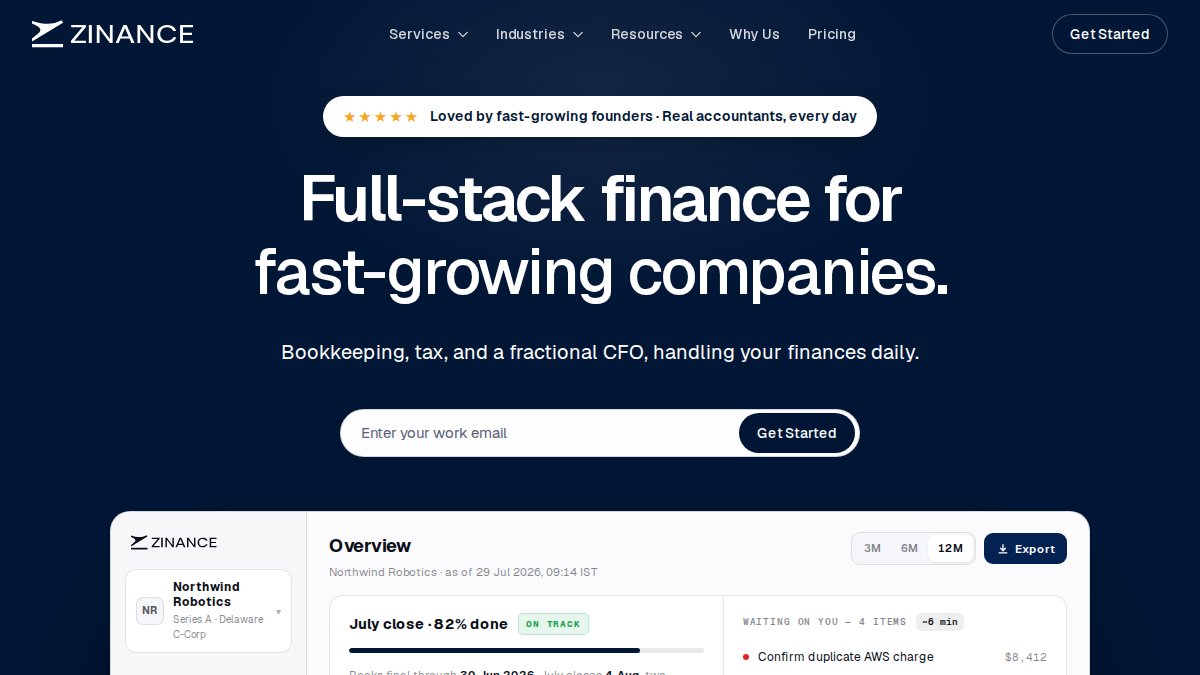
Zinance starts at $349/month for a human team, accrual-basis books, daily updates, and tax services. The published rate lets you budget, though confirm what the entry price covers.
inDinero publishes two plans: Basic at $600/month for startups under $150,000 in monthly expenses, and Founder Timesaver at $750/month for businesses at $150,000 or more. The expense-based split sensibly prices complexity, though feature detail at each tier is thin.
Best for: Founders who want a visible monthly number before the first call.
Skip if: Your transaction mix is unusual enough that a flat tier misprices you.
Where Startup Accounting Software Ends and a Service Begins
Startup accounting software records what happened. A service decides what it means and what to do next. That line matters more than any feature list.
Software handles categorization, reconciliation, and financial statements. It will not tell you your burn rate is drifting, that a tax credit applies to your R&D spend, or that your runway math assumes an unapproved hiring plan.
A common mistake is buying software to solve a service problem. For a done-for-you arrangement, accounting and bookkeeping services show what that handover looks like.
Outsourced Accounting for Startups: What You Actually Hand Over
Outsourced accounting for startups means transferring bookkeeping, monthly close, reconciliation, and reporting to an outside team while you keep ownership of the accounts and decisions. You hand over the work, not the company.
The handover covers categorization, reconciliation, the monthly close, GAAP-compliant statements, and the investor reporting pack. You keep bank access, approval authority, and strategic calls.
Watch out: the most common failure is a provider that takes the work but not the accountability. A proper cloud accounting service keeps your data in your name and your team in the loop.
Startup Accounting Service Pricing: Reading the Real Monthly Cost
Startup accounting service pricing is usually a monthly fee, but the real cost includes setup, catch-up work, tax filing, and hours spent managing the provider. Compare total cost of ownership, not the headline number.

Most comparison pages stop at the sticker price, which is the wrong number. Normalize every quote into the same annual total-cost-of-ownership (TCO) model. (Source: Internal Revenue Service (IRS) information on small business tax obligations)
The five-line TCO model
Build one spreadsheet per provider and fill in the same five lines for each:
- Base monthly fee (annualized): multiply the quoted monthly rate by 12. If pricing scales with transaction volume or monthly expenses, model your busiest expected month, not your current one.
- Onboarding and migration: one-time cost to move historical books, rebuild the chart of accounts, and reconnect bank and payroll feeds. Ask whether catch-up bookkeeping for prior periods is included or billed hourly.
- Tax work: separate the price of filing federal and state returns from proactive planning (entity elections, R&D credit documentation, state nexus review). Many providers bundle filing but bill planning separately.
- Add-ons: bill pay, payroll administration, accounts-receivable follow-up, sales-tax registration and filing, and CFO or advisory hours. Ask for the advisory hourly rate before you need it.
- Your internal time: estimate founder or ops hours per month spent reviewing the close, chasing corrections, and assembling investor reporting. Multiply by a reasonable internal hourly cost. This line is invisible on every quote and often the largest.
A worked example of why the headline misleads
Suppose Provider A quotes $349/month, bills tax filing separately, and needs about eight founder hours monthly. Provider B quotes $750/month, includes filing, and needs about three. On base fees alone, A looks roughly $400/month cheaper. Add the separate tax bill and five extra founder hours, and the gap narrows sharply, and can invert if A also charges hourly for catch-up or advisory calls.
We are not asserting specific competitor add-on prices because published pages rarely disclose them. The point is the method: force every provider onto the same five lines before deciding.
Questions that surface hidden cost
- Is the monthly fee capped, or does it rise with transaction volume or monthly expenses? What triggers the next tier?
- Is the monthly close included, or billed as a separate project?
- Are prior-period cleanup and catch-up bookkeeping included in onboarding?
Ask every provider for a single all-in annual figure in writing, itemized across the five lines above. A provider that will not put an annual number in writing is telling you the number is worse than the monthly quote suggests.
A lower monthly fee with separate tax billing and heavy founder oversight often costs more than a bundled quote. The only fair comparison is the annual total across the same five lines.
Matching the Provider to Your Stage, Complexity, and Tax Needs
Match the provider to your stage first, then complexity, then tax. A pre-revenue startup and a Series A company with multi-state payroll do not need the same service, and paying for either one’s requirements is waste.
A decision framework by stage
Use stage to set the floor, then complexity and tax to set the ceiling.
- Pre-revenue or idea stage: the books are mostly formation costs, founder compensation, and a handful of vendor bills. A software-plus-review setup or an entry human plan is enough. Do not pay for CFO advisory you cannot use yet.
- Early revenue, raising soon: prioritize investor-ready financials and a clean monthly close over breadth of features. What matters is a consistent close date, GAAP-compliant statements, and a reporting pack a diligence team can follow.
- Seed to Series A with payroll and multi-state activity: prioritize tax depth and a named accountant. This is where a generalist bookkeeping shop starts to strain on state registrations, payroll-tax filings, and nexus questions.
Complexity signals that should change your choice
Stage alone is blunt. Weight these signals heavily:
- Transaction volume: a high count of small transactions (payment-processor payouts, ad spend, contractor payments) rewards automation; a low count of large, negotiated transactions rewards human judgment.
- Entity structure: multiple entities, subsidiaries, or a holding company add consolidation work that entry plans rarely cover.
- Payroll and contractors: multi-state payroll and a contractor base in several states create registration and filing obligations that belong with a tax-capable provider.
Tax: filing is table stakes, planning is where the money is
Filing is the minimum; planning is the differentiator: entity-election review, R&D credit documentation, state nexus analysis, and quarterly estimates that avoid underpayment penalties. If you are weighing tax capability, our tax planning service shows what proactive work looks like, and our guide to early-stage startup tax planning goes deeper.
Switching from Pilot: a migration checklist
Most founders searching for an alternative are already a customer somewhere. Switching is a data-migration project, not a phone call, so sequence it deliberately:
- Export your data before you cancel. Confirm you can download the general ledger, chart of accounts, trial balances, bank and credit-card feeds, and supporting documents. Ask who owns the data and in what format it exports.
- Agree on a cutover date. Pick the first day of a month or quarter so the close does not straddle two providers.
- Map the chart of accounts. Have the new provider propose a mapping from your existing accounts to theirs, and review it before any historical data is loaded.
- Reconnect integrations. Bank feeds, payroll, payment processors, expense tools, and billing systems all need to be reauthorized. Build a checklist and confirm each one is live before the first close.
- Preserve close continuity. Confirm in writing who is responsible for the final close under the old provider, who handles the first close under the new one, and what happens to any open reconciling items.
- Run a parallel month if you can. A paid trial month lets you compare close date, accuracy, and responsiveness against your current setup before you commit.
The most common switching failure is canceling before the export is verified. Keep access to your old books until the new provider has completed at least one clean close.
Ask three questions on the first call: who owns my data and how do I export it, what is the migration timeline, and who is my named contact. Get the answers in writing. A provider that cannot answer all three clearly is telling you something.
Book a Consultation Before You Switch Accounting Providers
Switching providers is a data migration project, not a phone call. Plan it before you cancel anything.
Ask three questions on the call: who owns my data and how do I export it, what is the migration timeline, and who is my named contact. Get the answers in writing. A provider that cannot answer all three clearly is telling you something.
Then run a paid trial month if offered. Compare the close date, the accuracy, and the responsiveness against your current setup. If the trial month is worse than what you have, you have your answer.
Most founders tolerate a mismatched accounting provider for a year longer than they should, and the cost shows up as messy books at the worst possible moment: diligence. Momentum Tax offers a complimentary initial consultation, a secure portal for your documents, and proactive tax planning alongside cloud-based bookkeeping, backed by IRS Enrolled Agents and a CFP on the team. Book an appointment to see where you stand.
Frequently Asked Questions
What are the best alternatives to Pilot for startup accounting?
The right pilot alternative depends on what you want handled. Truewind adds AI-powered automation on top of QuickBooks Online or Sage, which suits teams that already run their own books. OpStart bundles bookkeeping, bill payment, budgeting, and tax services. Zinance starts at $349/month for a human team with accrual books and daily updates. inDinero lists Basic at $600/month and Founder Timesaver at $750/month. Compare each on scope, not just the headline rate.
How much do startup bookkeeping services cost each month?
Published starting rates in this category range from $349/month at Zinance to $600/month for inDinero’s Basic plan, with inDinero’s Founder Timesaver at $750/month. Several providers, including Truewind and OpStart, do not publish pricing and quote per engagement. Treat any starting figure as a floor: transaction volume, account count, payroll, and tax filing usually move the final number. Ask for a written scope alongside the quote.
Can startup accounting software replace a startup accountant?
Software handles transaction categorization, reconciliation, and reporting, but it does not sign off on GAAP-compliant financials or prepare and file your returns. Most startups pair a platform with a human reviewer. Products like Truewind are built as an automation layer over QuickBooks Online or Sage rather than a replacement for the accounting work itself. If you need investor-ready financials or tax compliance, plan for human review on top of the tool.
Is outsourced accounting for startups a good fit at the pre-revenue stage?
It can be, if you keep the scope narrow. Pre-revenue companies mainly need clean books, a correct chart of accounts, and a tax return filed on time. Full-service plans with budgeting and CFO support often cost more than an early-stage company needs. Start with bookkeeping and tax compliance, then add advisory support when you raise or when transaction volume grows. Ask each provider what a reduced scope costs before you sign.
What should a startup compare when choosing an accounting service?
Compare five things: the exact scope included at the quoted price, who does the work (dedicated accountant or rotating team), how and when you can reach a person, which software and integrations you keep access to, and what happens to your data if you leave. Also confirm who prepares and reviews tax filings and whether they hold CPA or Enrolled Agent credentials. Get the scope and exit terms in writing before switching providers.
